

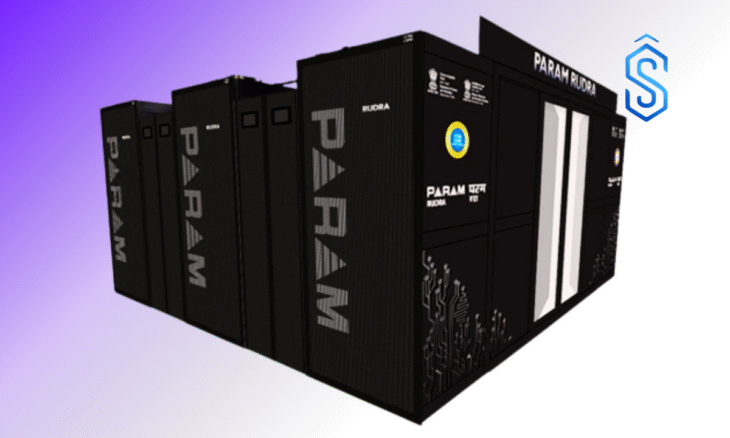
New Delhi: As part of India’s strategic push towards self-reliance in advanced computing, the government has deployed 37 supercomputers with a cumulative computing power of 40 Petaflops under the National Supercomputing Mission (NSM).
A key highlight of this initiative is the PARAM Rudra series of supercomputers, which are being actively used by researchers, scientists, engineers, startups, and academic institutions across the country.
Launched in April 2015 with an outlay of ₹4,500 crore, the National Supercomputing Mission is jointly implemented by the Ministry of Electronics and Information Technology (MeitY) and the Department of Science and Technology (DST).
The mission is executed through the Centre for Development of Advanced Computing (C-DAC), Pune, and the Indian Institute of Science (IISc), Bengaluru.
Also Read: IndiaAI Mission 2025: BharatGen Secures INR 988.6 Crore Funding
Deployment and Reach of PARAM Rudra under NSM
So far, 37 supercomputers have been commissioned under NSM, with 34 systems deployed in the last five years alone. Additionally, six new supercomputing systems are currently under deployment with a total outlay of ₹680 crore.
These installations span premier institutions such as IISc, IITs, C-DAC, national R&D laboratories, as well as several Tier-II and Tier-III cities, ensuring wider access to high-performance computing infrastructure.
PARAM Rudra: Indigenous Supercomputing Capability
The PARAM Rudra series of supercomputers has been built using indigenously designed and manufactured high-performance “Rudra” servers, complemented by a fully indigenous system software stack.
These systems are accessible to young researchers, scientists, and engineers, enabling advanced studies in areas such as physics, earth sciences, and cosmology.
Operational performance indicates high utilisation levels, with most systems operating at over 81% capacity and some exceeding 95%.
Collectively, these supercomputers have supported more than 13,000 researchers, including over 1,700 PhD scholars from more than 260 academic and research institutions.
Over one crore compute jobs have been completed, contributing to the publication of more than 1,500 research papers in reputed scientific journals.
Startups and MSMEs are also leveraging PARAM Rudra and other NSM systems to accelerate their high-performance computing–based projects across multiple domains.
Also Read: AI City Index 2025: Bengaluru Emerges Among Fastest-Growing AI Cities Globally
Research Impact Enabled by PARAM Rudra
The deployed supercomputers are driving advanced research in critical areas including drug discovery, disaster management, climate modelling, energy security, astronomy, aerospace engineering, materials science, computational chemistry, and fluid dynamics, among others.
Indigenous Development and Technology Advancements under NSM
The National Supercomputing Mission has established a comprehensive ecosystem focused on building indigenous supercomputing capabilities.
Key developments include the design and development of the Rudra server board by C-DAC, with manufacturing technology transferred to three Indian electronics manufacturing services partners.
High-speed interconnect networks supporting 40 Gbps and 100 Gbps have been developed, along with indigenous cooling technologies now entering the deployment stage.
In addition, a complete HPC system software stack has been developed and integrated into the supercomputing systems.
PARAM Shavak, a supercomputing-in-a-box solution, has been designed and manufactured domestically to meet the HPC and AI computing needs of students and researchers in engineering colleges and universities.
Several HPC applications of national importance have also been developed and deployed across domains such as genomics and drug discovery, flood forecasting, urban environment and weather modelling, seismic data processing for oil and gas, and material science, in collaboration with institutions including IMD, ONGC, CWC, CPCB, and the Ministry of Ayush.
Work has also been initiated on the design and development of indigenous HPC processors, accelerators, and storage technologies.
Details of Supercomputers deployed under NSM with compute capacitySl. No. State/UT Institution Supercomputer Compute Capacity Year Maharashtra C-DAC, Pune SANGAM Testbed 150 TF 2017 Maharashtra C-DAC, Pune PARAM Shrestha 100 TF 2018 Uttar Pradesh IIT(BHU), Varanasi PARAM Shivay 838 TF 2019 Maharashtra C-DAC Pune National AI Facility PARAM Siddhi 6.5 PF / 210 AI PF 2020 Karnataka JNCASR, Bangalore PARAM Yukti 1.8 PF 2020 Maharashtra IISER Pune PARAM Brahma 1.7 PF 2020 West Bengal IIT Kharagpur PARAM Shakti 1.66 PF 2020 Uttar Pradesh IIT Kanpur PARAM Sanganak 1.66 PF 2020 Maharashtra C-DAC Pune PARAM Embrio 100 TF 2020 Maharashtra C-DAC Pune PARAM Neel 100 TF 2020 Tamil Nadu SETS Chennai PARAM Spoorthi 100 TF 2020 Karnataka C-DAC Bangalore System Software Lab 82 TF 2020 Maharashtra C-DAC Pune PARAM Sampooran 27 TF 2020 Telangana IIT Hyderabad PARAM Seva 838 TF 2021 Punjab NABI Mohali PARAM Smriti 838 TF 2021 Karnataka C-DAC Bangalore MSME Facility PARAM Utkarsh 838 TF 2021 Maharashtra C-DAC Pune Bioinformatics R&D Facility 230 TF 2021 Karnataka IISc Bangalore PARAM Pravega 3.3 PF 2022 Uttarakhand IIT Roorkee PARAM Ganga 1.66 PF 2022 Gujarat IIT Gandhinagar PARAM Ananta 838 TF 2022 Tamil Nadu NIT Trichy PARAM Porul 838 TF 2022 Assam IIT Guwahati PARAM Kamrupa 838 TF 2022 Himachal Pradesh IIT Mandi PARAM Himalaya 838 TF 2022 Maharashtra C-DAC Pune PARAM Vidya 52.3 TF 2022 West Bengal IIT Kharagpur PARAM Vidya 52.3 TF 2022 Kerala IIT Palakkad PARAM Vidya 52.3 TF 2022 Tamil Nadu IIT Madras PARAM Vidya 52.3 TF 2022 Goa IIT Goa PARAM Vidya 52.3 TF 2022 Maharashtra C-DAC Pune PARAM Rudra Pilot facility 1 PF 2023 Delhi IUAC Delhi PARAM Rudra 3 PF 2024 Delhi NIC Delhi PARAM System 50 AI PF/1.3 PF 2024 Maharashtra GMRT–NCRA Pune PARAM Rudra 1 PF 2024 West Bengal S.N. Bose Centre Kolkata PARAM Rudra 833 TF 2024 Delhi C-DAC Delhi PARAM Rudra 200 TF 2024 Maharashtra IIT Bombay PARAM Rudra 3 PF 2025 Tamil Nadu IIT Madras PARAM Rudra 3 PF 2025 Bihar IIT Patna PARAM Rudra 833 TF 2025 Total 40 PF
This information was submitted by Union Minister of State for Electronics and Information Technology Shri Jitin Prasada in Lok Sabha on 10.12.2025.